FND 101 · Foundation Studio I: Seeing Relations · 6 credits
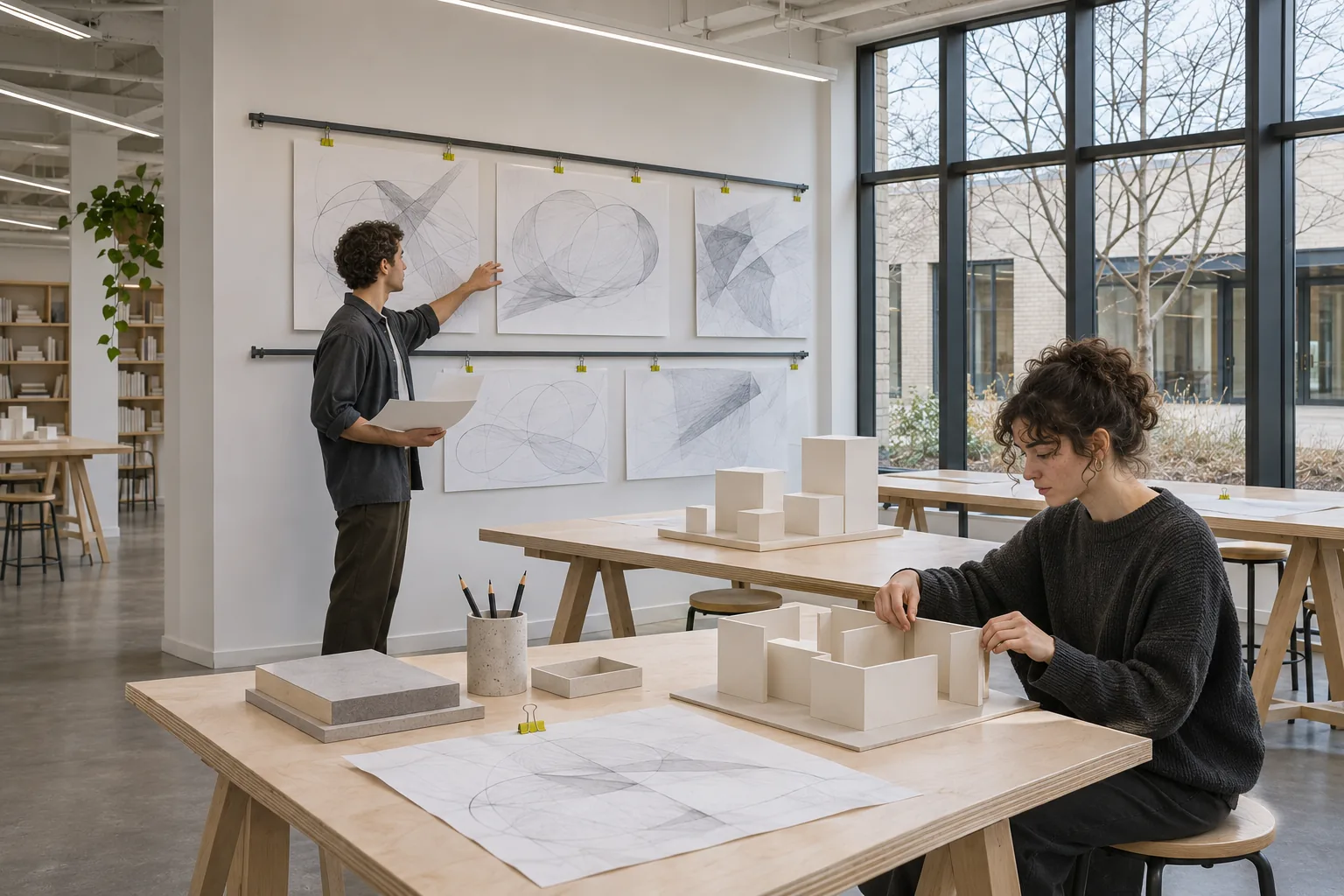
Observe relationships between an object, its setting and a person's described activity. Translate the observation into drawings and a modest physical model while identifying what each medium leaves out.
Assessment: A sequence of observation sheets, a simple model, a review presentation and a documented revision after feedback. Prerequisites: None. Corequisites: None. Learning time: 270 hours.
FND 110 · Drawing and Notation · 3 credits
Use line, viewpoint and a legend to make a spatial record readable. Distinguish the object being described from the conventions used to represent it.
Assessment: A drawing set with consistent notation, a legend and a correction sheet explaining where the first version was ambiguous. Prerequisites: None. Corequisites: None. Learning time: 135 hours.
FND 130 · Material Encounters · 3 credits
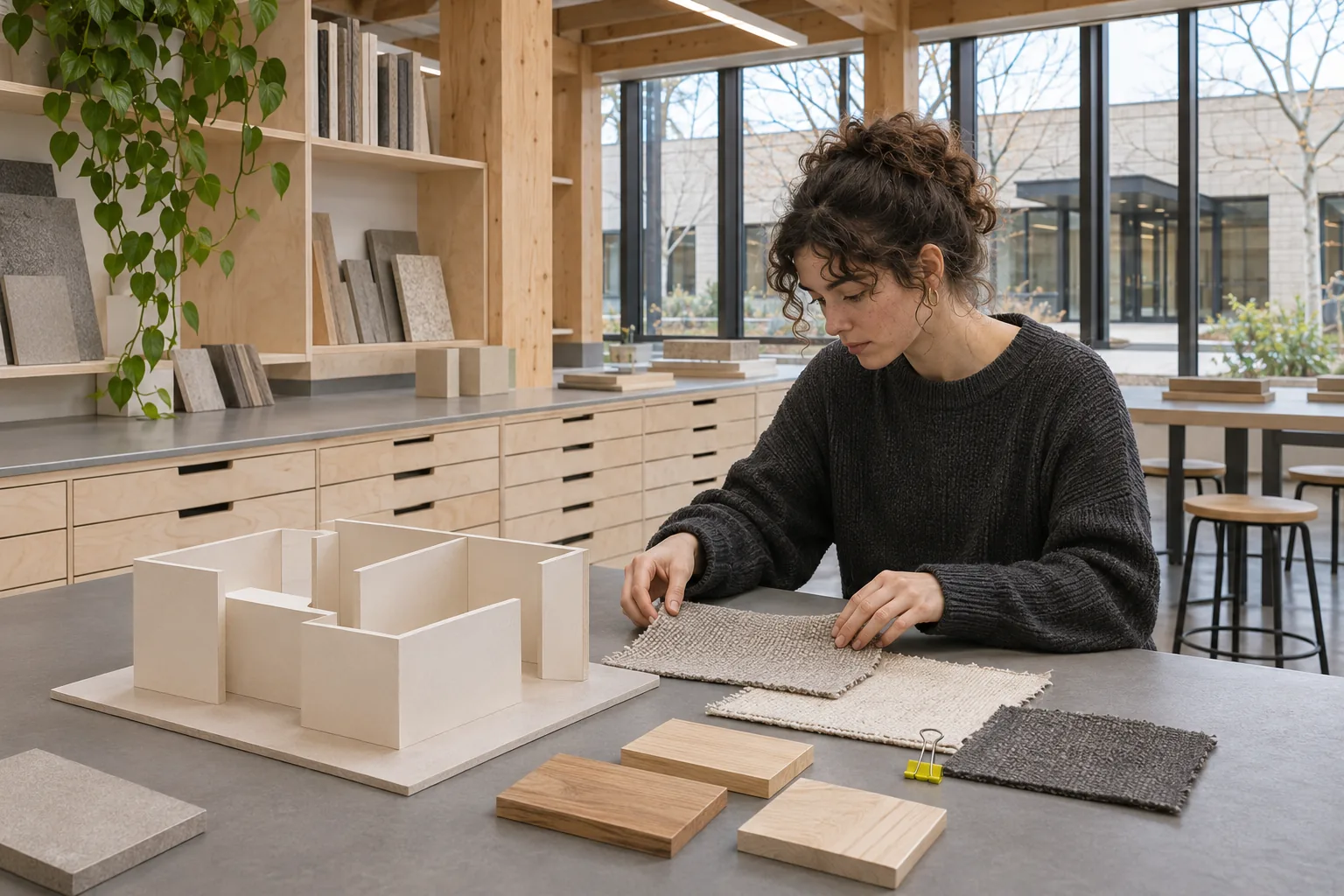
Describe a material sample through visible characteristics and documented provenance. Separate an observation from an untested statement about performance or environmental benefit.
Assessment: A sample-record book with source labels, observation sketches and a comparison that avoids unsupported performance claims. Prerequisites: None. Corequisites: None. Learning time: 135 hours.
GEN 101 · Writing about Place · 3 credits
Describe a place through a claim that a reader can inspect. Distinguish an observation, a supplied source and an interpretation when revising an account.
Assessment: A 1,200-word place essay with source notes, a marked revision and a short account of the changed claim. Prerequisites: None. Corequisites: None. Learning time: 135 hours.
FND 102 · Foundation Studio II: Making a Proposition · 6 credits
Turn a stated spatial question into a bounded proposition. Compare two arrangements and revise one through drawings, models and an explanation of the tradeoff.
Assessment: A two-version studio dossier with a task brief, drawings, model photographs and a reasoned response to a review question. Prerequisites: FND101. Corequisites: None. Learning time: 270 hours.
FND 120 · Records and Scale · 3 credits
Keep units, reference dimensions and version identifiers together when changing scale. Check that a drawing's stated size and a separate source table agree.
Assessment: A scale-conversion workbook, two controlled drawing sheets and a complete record of dimensions and output assumptions. Prerequisites: FND110. Corequisites: None. Learning time: 135 hours.
FND 140 · Observation and Context · 3 credits
Record the context in which a spatial question is asked. Compare a field-style note, an authored scenario and a diagram without presenting one as the whole place.
Assessment: A contextual observation dossier using invented site material, with a distinction between supplied facts and proposed interpretation. Prerequisites: FND110. Corequisites: None. Learning time: 135 hours.
GEN 102 · Quantitative Comparisons · 3 credits
Translate a spatial comparison into quantities with explicit units. Check a rate, denominator and rounding choice before using a number in an argument.
Assessment: A checked comparison workbook using proportions, areas and rates, with a written correction log for two initial errors. Prerequisites: None. Corequisites: None. Learning time: 135 hours.
INT 201 · Interior Studio III: Occupied Room · 6 credits
Develop a room proposition from a supplied set of activities and objects. Compare how positions and relationships change the account of use without claiming to observe real occupants.
Assessment: A two-arrangement room project with controlled object records, a model and a discussion of the selected tradeoff. Prerequisites: FND102. Corequisites: None. Learning time: 270 hours.
INT 210 · Room Layout and Use · 3 credits
Compare two arrangements using the same supplied room and object list. Explain a change in relationships without asserting that the drawing certifies safety or universal access.
Assessment: A paired room-layout study with object coordinates, source dimensions and an account of the chosen arrangement. Prerequisites: FND120. Corequisites: None. Learning time: 135 hours.
GEN 103 · Histories and Narratives · 3 credits
Read two accounts of the same period without treating either as a complete record. Explain how selection, sequence and authorship change a historical narrative.
Assessment: A paired-source commentary that distinguishes the supplied evidence from the student's interpretation and identifies an unanswered question. Prerequisites: None. Corequisites: None. Learning time: 135 hours.
GEN 106 · Speaking with an Audience · 3 credits
Organize a short spoken explanation around an audience's question. Use a visual aid as support for a claim rather than as a substitute for speaking clearly.
Assessment: A recorded five-minute explanation, an accessible outline and a reflection comparing the first and revised presentation. Prerequisites: None. Corequisites: None. Learning time: 135 hours.
PRC 130 · Material Origins · 3 credits
Trace the documented origin of a teaching sample or object. Distinguish a supplied source statement from an unsupported claim about the material's wider history or impact.
Assessment: A material provenance dossier with source labels, an observation drawing and a record of unresolved origin questions. Prerequisites: FND110. Corequisites: None. Learning time: 135 hours.
INT 202 · Interior Studio IV: Linked Interiors · 6 credits
Connect two interior situations through a stated sequence of use. Keep the transition legible in drawings and a model while considering different readings of the brief.
Assessment: A linked-interior study with two alternatives, source dimensions and a revised account of the transition. Prerequisites: INT201. Corequisites: None. Learning time: 270 hours.
INT 220 · Material Assemblies in Interiors · 3 credits
Explain how a set of material layers is represented in a teaching interior. Keep documented observations separate from untested statements about durability, fire or environmental performance.
Assessment: An interior assembly dossier with sample provenance, relationship drawings and an explicit specialist-question list. Prerequisites: INT210. Corequisites: None. Learning time: 135 hours.
GEN 105 · Scientific Questions · 3 credits
Frame a question that can be investigated with a stated method. Separate a variable, an observation and an explanation without claiming that a classroom exercise proves a general result.
Assessment: A small supplied-data inquiry with an explicit question, method comparison and statement of what the record cannot establish. Prerequisites: None. Corequisites: None. Learning time: 135 hours.
PRC 140 · Objects and Use · 3 credits
Compare how an object is described through material, use and context. Explain why a visible surface alone cannot establish performance, durability or cultural meaning.
Assessment: An object study with two contextual readings, documented observations and a limits statement. Prerequisites: FND120. Corequisites: None. Learning time: 135 hours.
INT 301 · Interior Studio V: Material Relations · 6 credits
Use documented material observations to develop an interior proposition. Explain the relation between surface, object and activity without turning a sample into a performance certificate.
Assessment: A material-led interior dossier, sample records, model studies and a critical comparison of two decisions. Prerequisites: INT202. Corequisites: None. Learning time: 270 hours.
INT 310 · Light as a Spatial Record · 3 credits
Describe the role of light in an authored interior scenario. Compare representational choices without presenting the exercise as a measured illumination or energy study.
Assessment: A paired light-description study using supplied scenario cards, model photographs and a statement of what was not measured. Prerequisites: INT220. Corequisites: None. Learning time: 135 hours.
INT 330 · Interior Histories · 3 credits
Read accounts of interiors through objects, documents and the questions their authors ask. Compare two interpretations without reducing a period or community to one visual style.
Assessment: A historical interior reading with a source trail, object analysis and a response to an alternative interpretation. Prerequisites: FND102. Corequisites: None. Learning time: 135 hours.
GEN 202 · Argument and Revision · 3 credits
Develop a sustained argument from an initial question and a set of sources. Revise the structure when counterevidence changes what the claim can support.
Assessment: A 1,800-word argument, a response to a counterclaim and a revision letter explaining three substantive changes. Prerequisites: GEN101. Corequisites: None. Learning time: 135 hours.
PRC 230 · Material Records · 3 credits
Keep quantities, units and source descriptions consistent when revising a material board. Compare a retained item with a proposed replacement without inventing environmental certifications.
Assessment: A two-board material record with a complete item table, revision reasons and a checked quantity comparison. Prerequisites: PRC140. Corequisites: None. Learning time: 135 hours.
INT 302 · Interior Studio VI: Adaptation · 6 credits
Reconsider an interior proposition when its described use changes. Identify what can be retained, what must be revised and what the teaching record does not establish.
Assessment: An adaptation project with retained/changed elements, coordinated versions and a statement of unresolved practical questions. Prerequisites: INT301. Corequisites: None. Learning time: 270 hours.
INT 320 · Furniture and Edges · 3 credits
Trace how furniture positions define edges and relationships in a room. Check that the object list, plan and written explanation refer to the same version.
Assessment: A furniture-edge comparison with a checked object schedule, two drawings and a correction log. Prerequisites: INT310. Corequisites: None. Learning time: 135 hours.
GEN 108 · Statistics in Context · 3 credits
Read a small dataset with attention to its population and missing values. Compare a summary with the individual records before making an inference.
Assessment: A checked descriptive-statistics report using a supplied simulated dataset, including the denominator and a missing-data note. Prerequisites: GEN102. Corequisites: None. Learning time: 135 hours.
PRC 240 · Reuse Scenarios · 3 credits
Compare authored reuse scenarios while keeping their assumptions visible. Distinguish a proposed second use from evidence that a real material has been assessed or approved for it.
Assessment: A scenario comparison with a material record, stated exclusions and a revised description of the proposed reuse. Prerequisites: PRC230. Corequisites: None. Learning time: 135 hours.
INT 401 · Interior Studio VII: Independent Brief · 6 credits
Formulate an individual interior question under supervision. Define the scope of an authored brief and build a source record before selecting a spatial proposition.
Assessment: An independent brief, exploratory arrangements, a model and a final-term development plan supported by source notes. Prerequisites: INT302. Corequisites: None. Learning time: 270 hours.
INT 410 · Care and Adaptation · 3 credits
Consider how a proposal explains care, change and continued use. Distinguish a learning argument from a claim that a real owner has adopted the proposed arrangement.
Assessment: An adaptation argument with a responsibility diagram and a revised account of the project's stated limits. Prerequisites: INT330. Corequisites: None. Learning time: 135 hours.
GEN 301 · Research Writing · 3 credits
Build a researchable question from a project record and a reading trail. Organize evidence so that another reader can follow both the argument and its limits.
Assessment: A 2,500-word research paper, an annotated source list and a file showing how the question narrowed during review. Prerequisites: GEN202, GEN102. Corequisites: None. Learning time: 135 hours.
PRC 330 · Material Culture Argument · 3 credits
Develop an argument about the cultural account attached to a material collection. Compare the supplied sources and identify whose account remains missing from the selection.
Assessment: A source-based material-culture essay with an annotated collection and a response to a competing argument. Prerequisites: PRC240. Corequisites: None. Learning time: 135 hours.
INT 402 · Interior Studio VIII: Final Interior Proposition · 6 credits
Develop the approved interior question through a final unbuilt proposition. Coordinate objects, material descriptions and spatial records while explaining the limits of the proposal.
Assessment: A final interior presentation with controlled drawings, model views, an attribution record and a critical review statement. Prerequisites: INT401. Corequisites: None. Learning time: 270 hours.
INT 420 · Interior Portfolio of Revisions · 2 credits
Select interior records that show the development of a question and its response to review. Retain source credits and distinguish shared work from the student's own contribution.
Assessment: A curated interior portfolio with a revision narrative, contribution notes and a complete source list. Prerequisites: INT401. Corequisites: INT402. Learning time: 90 hours.
GEN 206 · Images and Society · 3 credits
Examine what an image includes, excludes and asks its audience to accept. Distinguish description, interpretation and a claim about the people represented.
Assessment: A visual-source essay with an image description, provenance notes and an alternative reading of the same material. Prerequisites: None. Corequisites: None. Learning time: 135 hours.
GEN 302 · Perspectives on Technology · 3 credits
Compare accounts of what a technology changes and for whom. Examine a claimed improvement alongside maintenance, access and the work omitted from the account.
Assessment: A comparative technology essay with a diagram of the claimed process and a discussion of an excluded perspective. Prerequisites: GEN105. Corequisites: None. Learning time: 135 hours.
PRC 340 · Material Portfolio · 3 credits
Curate a material inquiry so that source, observation and interpretation remain distinguishable. Show how a question and a selected set of records changed after review.
Assessment: A material portfolio with source credits, a revision narrative and a critical account of unresolved provenance. Prerequisites: PRC330. Corequisites: None. Learning time: 135 hours.