minor detail
Urban Inquiry
Compare urban sources and turn a place question into a reasoned account.
What the minor asks
Read fictional place records, public narratives and planning-style texts while preserving the difference between evidence and interpretation.
A degree-attached minor, not a stand-alone qualification or an external professional credential.
Six courses, eighteen credits
| Code | Course | Credits | Assessment |
|---|---|---|---|
| URB 110 | Place Records | 3 | An indexed fictional place-record pack with category definitions and a note on information not supplied. |
| URB 120 | Public Narratives | 3 | A two-narrative comparison with a common fact list, annotations and a revised passage. |
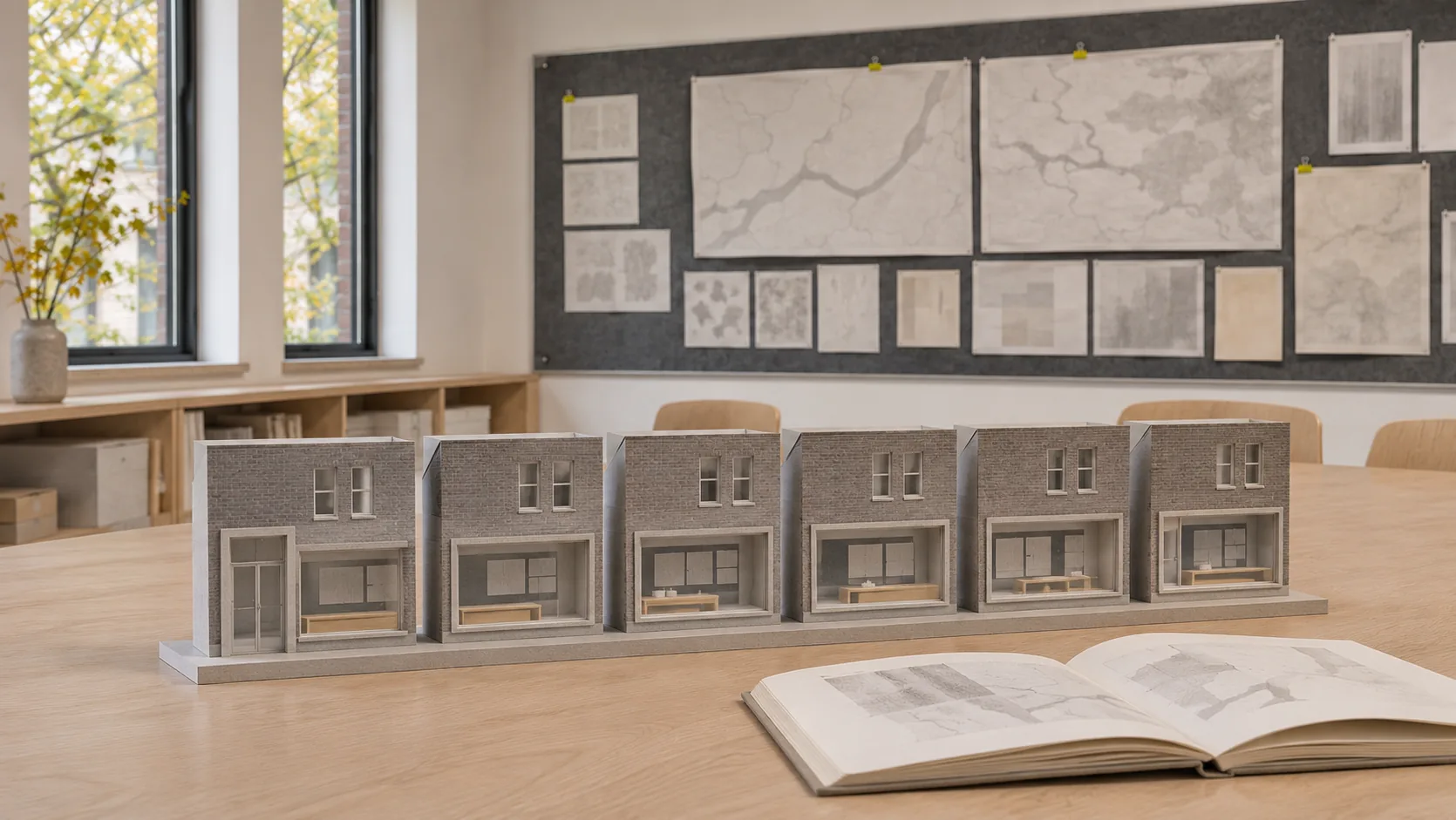
| URB 210 | Frontages and Use | 3 | A six-frontage record, two source-based narratives and a checked category summary with an interpretation note. |
| URB 220 | Everyday Institutions | 3 | An institutional-place dossier with a responsibility map, source commentary and an alternative interpretation. |
| URB 310 | Comparing Spatial Evidence | 3 | An evidence comparison with a discrepancy log and a revised diagram grounded in the complete source record. |
| URB 320 | Planning Documents as Texts | 3 | An annotated fictional document, a reading guide and a note separating the exercise from a real planning decision. |
Counting and residency
Six distinct 3-credit courses replace the 18-credit elective category. Foundation and primary-major requirements cannot also count toward these 18 credits. A declaration and advising review are separate from taking the courses.
A minimum of 12 minor credits must be completed at Marnstead, with at least grade C.
Verified routes
| Degree | Total | Extra credits | Extra semesters |
|---|---|---|---|
| Architectural Studies | 128 | 0 | 0 |
| Interior Environments | 128 | 0 | 0 |
| Landscape & Place Studies | 120 | 0 | 0 |
Visual notes