FND 101 · Foundation Studio I: Seeing Relations · 6 credits
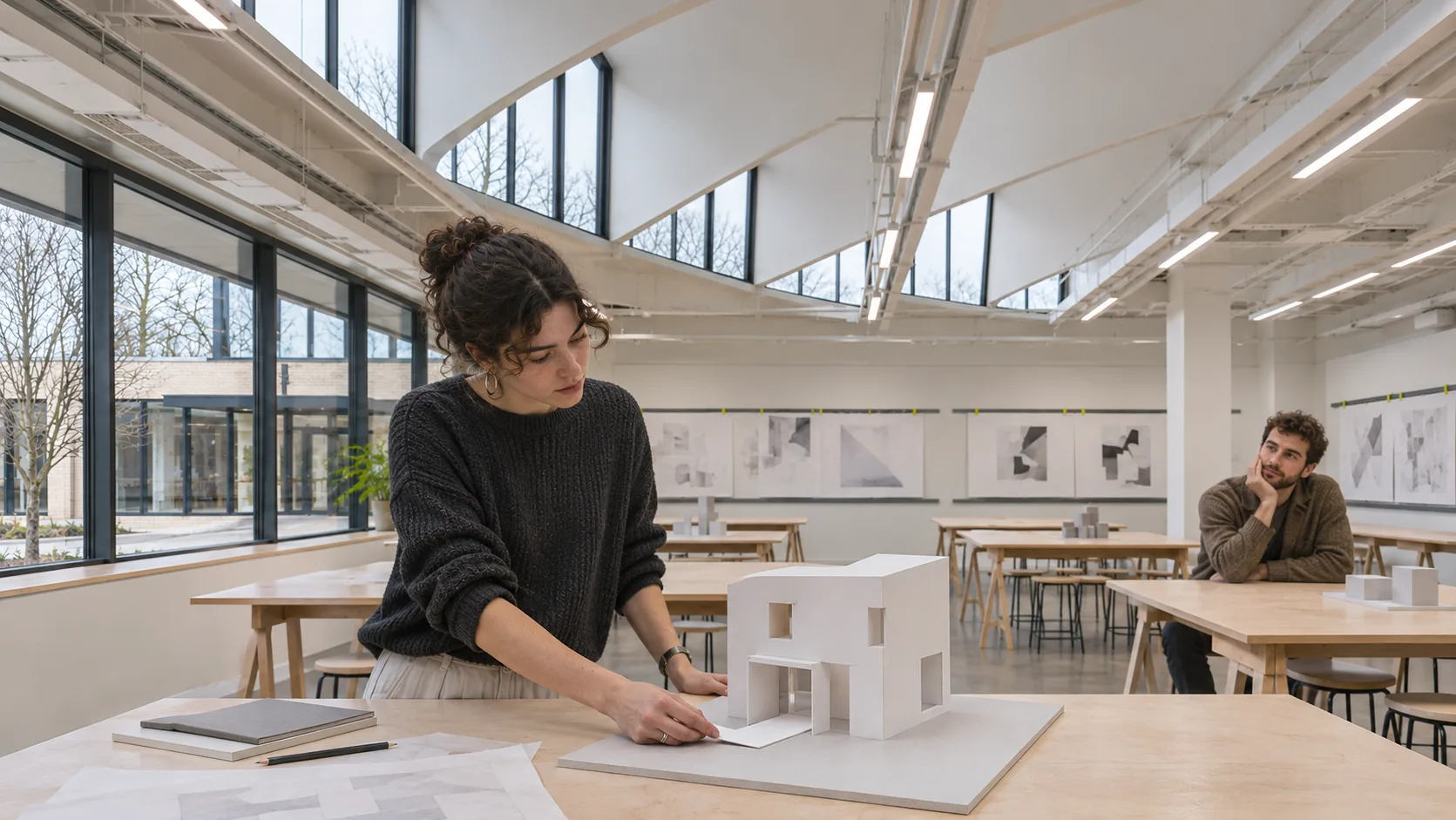
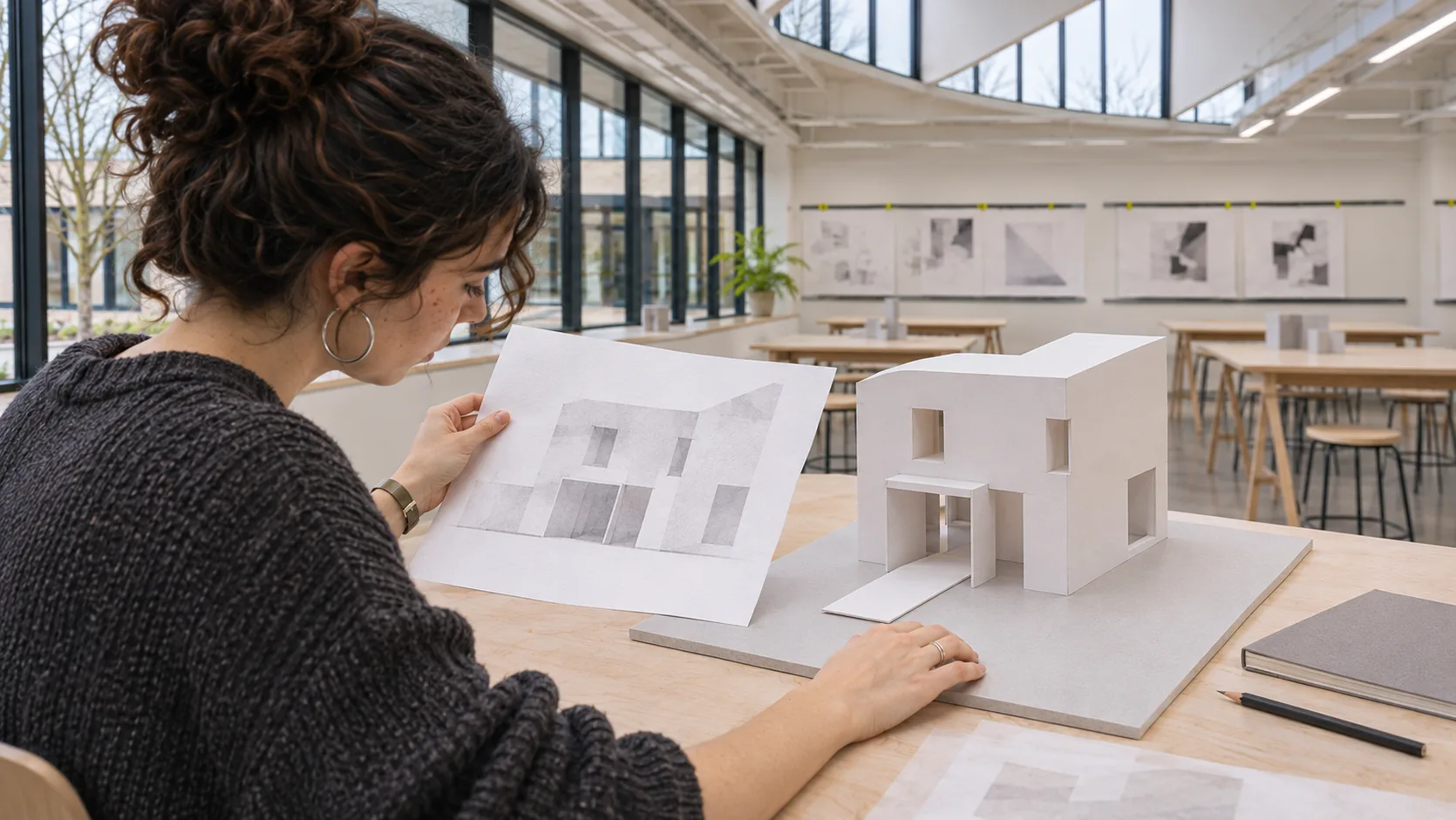
Observe relationships between an object, its setting and a person's described activity. Translate the observation into drawings and a modest physical model while identifying what each medium leaves out.
Assessment: A sequence of observation sheets, a simple model, a review presentation and a documented revision after feedback. Prerequisites: None. Corequisites: None. Learning time: 270 hours.
FND 110 · Drawing and Notation · 3 credits
Use line, viewpoint and a legend to make a spatial record readable. Distinguish the object being described from the conventions used to represent it.
Assessment: A drawing set with consistent notation, a legend and a correction sheet explaining where the first version was ambiguous. Prerequisites: None. Corequisites: None. Learning time: 135 hours.
FND 130 · Material Encounters · 3 credits
Describe a material sample through visible characteristics and documented provenance. Separate an observation from an untested statement about performance or environmental benefit.
Assessment: A sample-record book with source labels, observation sketches and a comparison that avoids unsupported performance claims. Prerequisites: None. Corequisites: None. Learning time: 135 hours.
GEN 101 · Writing about Place · 3 credits
Describe a place through a claim that a reader can inspect. Distinguish an observation, a supplied source and an interpretation when revising an account.
Assessment: A 1,200-word place essay with source notes, a marked revision and a short account of the changed claim. Prerequisites: None. Corequisites: None. Learning time: 135 hours.
FND 102 · Foundation Studio II: Making a Proposition · 6 credits
Turn a stated spatial question into a bounded proposition. Compare two arrangements and revise one through drawings, models and an explanation of the tradeoff.
Assessment: A two-version studio dossier with a task brief, drawings, model photographs and a reasoned response to a review question. Prerequisites: FND101. Corequisites: None. Learning time: 270 hours.
FND 120 · Records and Scale · 3 credits
Keep units, reference dimensions and version identifiers together when changing scale. Check that a drawing's stated size and a separate source table agree.
Assessment: A scale-conversion workbook, two controlled drawing sheets and a complete record of dimensions and output assumptions. Prerequisites: FND110. Corequisites: None. Learning time: 135 hours.
FND 140 · Observation and Context · 3 credits
Record the context in which a spatial question is asked. Compare a field-style note, an authored scenario and a diagram without presenting one as the whole place.
Assessment: A contextual observation dossier using invented site material, with a distinction between supplied facts and proposed interpretation. Prerequisites: FND110. Corequisites: None. Learning time: 135 hours.
GEN 102 · Quantitative Comparisons · 3 credits
Translate a spatial comparison into quantities with explicit units. Check a rate, denominator and rounding choice before using a number in an argument.
Assessment: A checked comparison workbook using proportions, areas and rates, with a written correction log for two initial errors. Prerequisites: None. Corequisites: None. Learning time: 135 hours.
ARC 201 · Architecture Studio III: Threshold · 6 credits
Develop an unbuilt threshold proposition from a stated sequence of activities. Test how a change in entry alters the relation between an edge, a room and a route.
Assessment: A threshold project with three iterations, a model, controlled plan-section records and a review response. Prerequisites: FND102. Corequisites: None. Learning time: 270 hours.
ARC 210 · Thresholds and Spatial Sequence · 3 credits
Compare how a threshold connects a route and a room in an authored exercise. Keep area units and version changes explicit while explaining the reason for an arrangement.
Assessment: A three-version threshold comparison with complete source dimensions, area checks and a written revision rationale. Prerequisites: FND120. Corequisites: None. Learning time: 135 hours.
GEN 103 · Histories and Narratives · 3 credits
Read two accounts of the same period without treating either as a complete record. Explain how selection, sequence and authorship change a historical narrative.
Assessment: A paired-source commentary that distinguishes the supplied evidence from the student's interpretation and identifies an unanswered question. Prerequisites: None. Corequisites: None. Learning time: 135 hours.
GEN 104 · Civic Reading · 3 credits
Identify the purpose and audience of a public document. Separate a stated procedure, an institutional responsibility and a reader's proposed response.
Assessment: An annotated fictional public-document pack and a concise reading guide for a person approaching the issue for the first time. Prerequisites: None. Corequisites: None. Learning time: 135 hours.
PRC 110 · Lines and Claims · 3 credits
Compare how line choices change the claim a drawing appears to make. Explain a notation decision through a reader's task rather than a preferred graphic style.
Assessment: A drawing comparison with a common source record, a legend and a revised explanation of the line choices. Prerequisites: FND110. Corequisites: None. Learning time: 135 hours.
ARC 202 · Architecture Studio IV: Shared Room · 6 credits
Organize a small shared-room proposition around competing uses. Compare spatial sequences without treating an attractive image as evidence that every user need is resolved.
Assessment: A shared-room dossier with two alternatives, an explicit use brief and a reasoned selection after a peer review. Prerequisites: ARC201. Corequisites: None. Learning time: 270 hours.
ARC 220 · Assemblies as an Explanation · 3 credits
Describe an assembly through the relationship of its parts rather than an appearance alone. Distinguish a teaching diagram from a tested construction specification.
Assessment: An assembly explanation with labelled component relations, a model study and a note on questions requiring specialist verification. Prerequisites: ARC210. Corequisites: None. Learning time: 135 hours.
GEN 105 · Scientific Questions · 3 credits
Frame a question that can be investigated with a stated method. Separate a variable, an observation and an explanation without claiming that a classroom exercise proves a general result.
Assessment: A small supplied-data inquiry with an explicit question, method comparison and statement of what the record cannot establish. Prerequisites: None. Corequisites: None. Learning time: 135 hours.
PRC 120 · Model Reading · 3 credits
Read a physical teaching model alongside its stated source. Identify which relationships are represented and which details the model intentionally omits.
Assessment: A model-reading dossier with annotated photographs, a source list and an account of three omissions. Prerequisites: FND120. Corequisites: None. Learning time: 135 hours.
ARC 301 · Architecture Studio V: Building Relations · 6 credits
Connect spaces, edges and a described setting in one unbuilt proposal. Keep the project question visible as the plan, section and model become more detailed.
Assessment: An integrated studio set with a relation diagram, coordinated drawings, model views and a substantive revision log. Prerequisites: ARC202. Corequisites: None. Learning time: 270 hours.
ARC 310 · Enclosure and Interfaces · 3 credits
Compare how an enclosure is represented at an opening and an edge. Identify gaps between the drawn relationship and any untested claim about actual performance.
Assessment: An interface study with paired sections, a source reference table and an explicit list of unverified performance questions. Prerequisites: ARC220. Corequisites: None. Learning time: 135 hours.
ARC 330 · Architectural Precedent as Argument · 3 credits
Read a supplied precedent dossier as an authored selection. Explain how one spatial relationship informs a question without treating a precedent as a design rule.
Assessment: A precedent argument with redrawn relationship diagrams, source acknowledgements and a comparison with a competing reading. Prerequisites: FND102. Corequisites: None. Learning time: 135 hours.
GEN 202 · Argument and Revision · 3 credits
Develop a sustained argument from an initial question and a set of sources. Revise the structure when counterevidence changes what the claim can support.
Assessment: A 1,800-word argument, a response to a counterclaim and a revision letter explaining three substantive changes. Prerequisites: GEN101. Corequisites: None. Learning time: 135 hours.
PRC 210 · Scale and Omission · 3 credits
Compare two representations of the same authored object at different scales. Calculate their stated dimensions and explain the information selected or omitted at each scale.
Assessment: A paired-scale study with complete source dimensions, omission records and a checked conversion table. Prerequisites: PRC120. Corequisites: None. Learning time: 135 hours.
ARC 302 · Architecture Studio VI: Context and Change · 6 credits
Revise a proposal when a supplied contextual assumption changes. Explain what remains stable and what must be reconsidered rather than hiding the change in a new rendering.
Assessment: A before-and-after proposal with an assumption register and a review essay tracing the effect of the changed brief. Prerequisites: ARC301. Corequisites: None. Learning time: 270 hours.
ARC 320 · Coordinated Section Records · 3 credits
Check whether plan and section versions describe the same proposition. Trace reference points and revise a mismatch without silently overwriting its history.
Assessment: A coordinated record set, a discrepancy register and a short explanation of the corrections made between versions. Prerequisites: ARC310. Corequisites: None. Learning time: 135 hours.
GEN 107 · Ethics and Evidence · 3 credits
Recognize where a proposal depends on a value judgement rather than a measurement. Compare responsibilities to people represented in a teaching scenario and justify a bounded response.
Assessment: An ethical case commentary that names two competing responsibilities, explains a decision and retains a serious objection. Prerequisites: None. Corequisites: None. Learning time: 135 hours.
PRC 220 · Comparative Representation · 3 credits
Compare plan, section, model and prose as different accounts of one question. Revise one account when another exposes an ambiguity in the represented relationship.
Assessment: A four-medium comparison with a discrepancy record and a revised representation supported by the same source. Prerequisites: PRC210. Corequisites: None. Learning time: 135 hours.
ARC 401 · Architecture Studio VII: Independent Question · 6 credits
Define an individual architectural question within a supervised teaching brief. Assemble a defensible source record and test an initial proposition through more than one medium.
Assessment: An independent-question proposal with a source dossier, first-stage drawings and models, and a review plan for the final term. Prerequisites: ARC302. Corequisites: None. Learning time: 270 hours.
ARC 410 · Context and Unbuilt Proposals · 3 credits
Evaluate how a final proposal describes the place around it. Separate a supplied contextual condition from an invented benefit or an unsupported claim of public approval.
Assessment: A critical context statement with a claim-evidence table and a revised description of an unbuilt proposal. Prerequisites: ARC330. Corequisites: None. Learning time: 135 hours.
GEN 301 · Research Writing · 3 credits
Build a researchable question from a project record and a reading trail. Organize evidence so that another reader can follow both the argument and its limits.
Assessment: A 2,500-word research paper, an annotated source list and a file showing how the question narrowed during review. Prerequisites: GEN202, GEN102. Corequisites: None. Learning time: 135 hours.
PRC 310 · Drawing Narratives · 3 credits
Organize a sequence of drawings around an argument that a reader can follow. Check that captions and transitions distinguish source facts from proposed interpretations.
Assessment: A two-version drawing narrative with complete captions, source credits and an editorial revision statement. Prerequisites: PRC220. Corequisites: None. Learning time: 135 hours.
ARC 402 · Architecture Studio VIII: Final Proposition · 6 credits
Develop and critically revise the approved studio question into an unbuilt final proposition. Make the relationship between evidence, decisions and unresolved questions inspectable.
Assessment: A final studio presentation with coordinated records, model documentation and a critical statement of the proposal's limits. Prerequisites: ARC401. Corequisites: None. Learning time: 270 hours.
ARC 420 · Architecture Portfolio of Revisions · 2 credits
Select records that make an architectural learning process understandable. Show how a decision changed and retain attribution, version dates and unresolved questions in the selection.
Assessment: A curated portfolio of revisions, a source/credit list and an editorial statement accompanying the final studio project. Prerequisites: ARC401. Corequisites: ARC402. Learning time: 90 hours.
GEN 204 · Environmental Questions · 3 credits
Distinguish a description of an environmental concern from a tested explanation. Compare scales, units and uncertainty when reading claims about places and resources.
Assessment: A source-comparison paper that checks two environmental claims and explains why the available evidence does not settle every question. Prerequisites: None. Corequisites: None. Learning time: 135 hours.
GEN 302 · Perspectives on Technology · 3 credits
Compare accounts of what a technology changes and for whom. Examine a claimed improvement alongside maintenance, access and the work omitted from the account.
Assessment: A comparative technology essay with a diagram of the claimed process and a discussion of an excluded perspective. Prerequisites: GEN105. Corequisites: None. Learning time: 135 hours.
PRC 320 · Representation Review · 3 credits
Evaluate a representation dossier against its declared purpose and source limits. Explain where a compelling graphic remains ambiguous or claims more than the evidence allows.
Assessment: A reviewed representation portfolio, an evidence/claim table and a final revision responding to two critical questions. Prerequisites: PRC310. Corequisites: None. Learning time: 135 hours.